Navigating 2026: Coastal Shipping — The Business Case Comes Before the Good Case

MPC International's Peter Creeden will join Professor Michael Bell of the University of Sydney for the opening keynote at the Australian Maritime Logistics Research Network (AMLRN) Annual Symposium 2026, hosted…

Date:
Category:

The benefits are proven

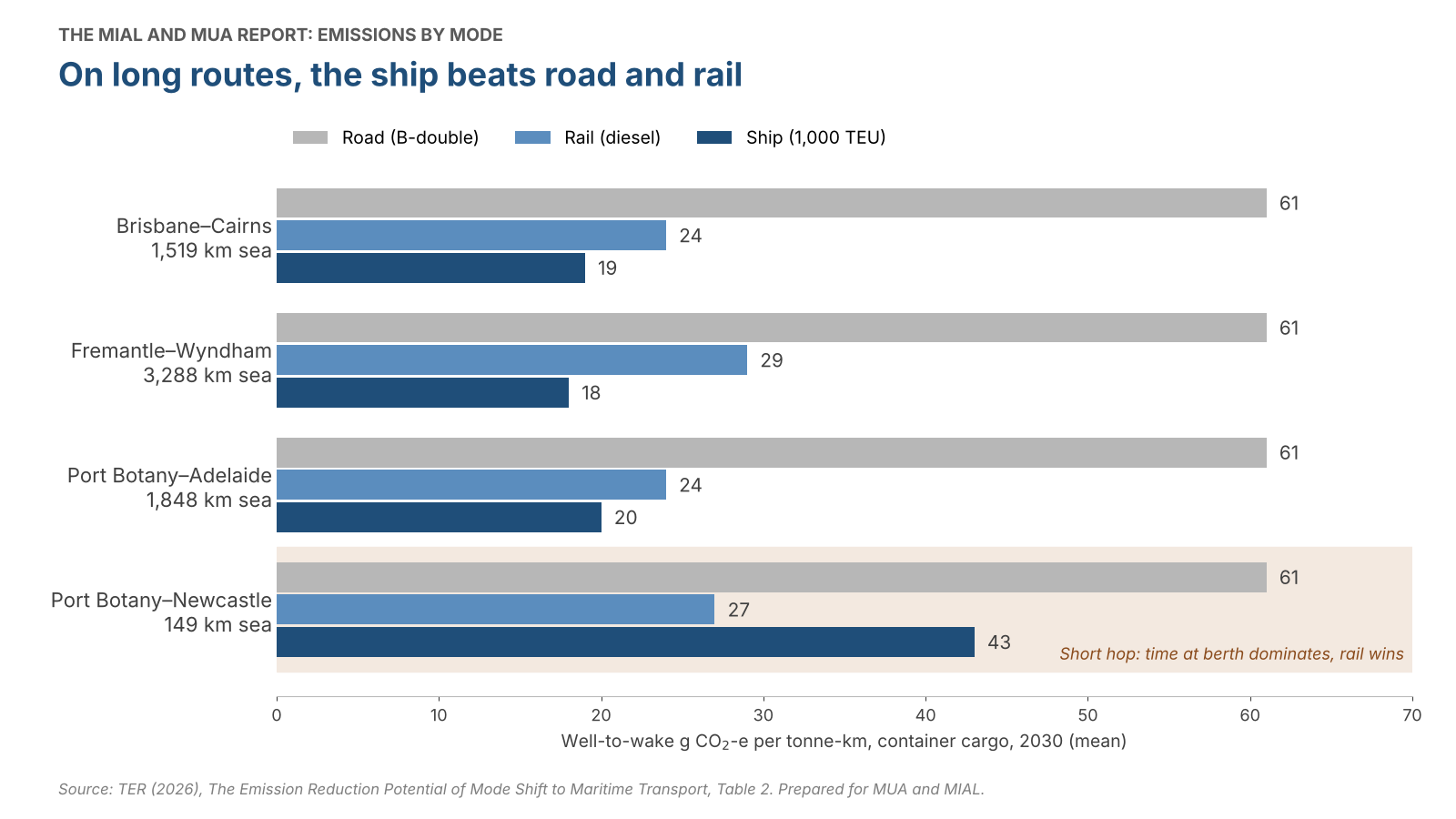
MIAL and the MUA have done the industry a real service. Their report, The Emission Reduction Potential of Mode Shift to Maritime Transport, prepared by Transport Energy/Emission Research with support from the Energy Futures Foundation, puts hard numbers on coastal shipping. On routes over about 1,400 km, moving containers from truck to ship cuts emissions per tonne-km by 60 to 70 per cent. A union and a shipowners’ association commissioning the same study is a signal in itself.

On 27 October, MIAL and the Global Maritime Forum convened a first-mover roundtable in Melbourne. My thanks to Clare Grandison and the MIAL team for bringing the right people into one room and keeping the conversation frank.

For anyone who wants to do the right thing, the case is made. The trouble is that doing the right thing does not move the Australian freight buyer.

Cost is the motivator, and now is the time

The roundtable said as much. Participants felt customer interest in low-emission shipping has plateaued. Freight buyers choose on landed cost and reliability, so the case for coastal shipping has to start with the invoice.

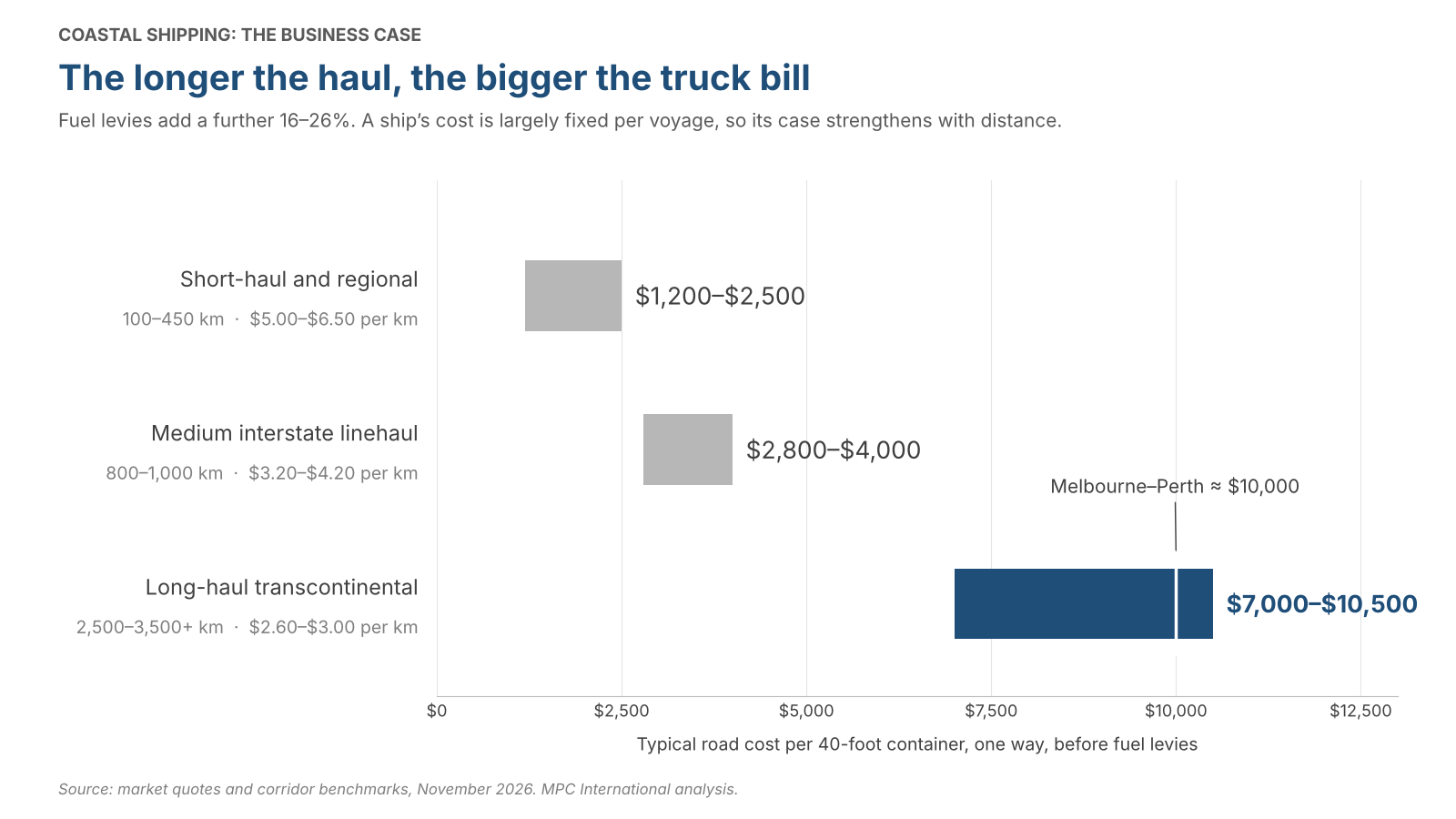
The invoice is telling us something. Road rates for a 40-foot container fall into three distance bands, with fuel levies of 16 to 26 per cent on top.

Short regional hauls pay the most per kilometre, because terminal waits, equipment minimums and driver shifts are spread over fewer kilometres. Wharf collections add booking slot fees, container chain charges and detention risk. The surprise is at the long end. A 40-foot box from Melbourne to Perth now costs roughly $10,000, close to $3 a kilometre. A ship’s cost is largely fixed per voyage and spread across hundreds of boxes, so the longer the haul, the stronger its case. The same logic runs up the Queensland coast and into the north-west, where distances are long, and rail is thin. Emissions and economics point the same way. The timing matters. Fuel levies swing with diesel, capital-city terminal and empty container park charges keep climbing, and the Coastal Trading Act is under review. Coastal shipping should be one of the answers freight buyers find.

Make the ship as easy to buy as the truck

A freight buyer who books a truck makes one call, gets one price to the door, and knows when the box arrives. Coastal shipping asks the same buyer to think in port pairs, voyages and licences. Until that changes, the cheaper option will keep losing to the easier one.

Supporting behaviour change means taking the friction out:

  • One door-to-door price. Bundle the cartage at both ends, so shippers compare like with like. New Zealand already has specialist forwarders focused on coastal bookings, who make switching from road to ship as simple as booking a truck.
  • A fixed-day schedule. Weekly, published and kept, so a buyer can move a whole product line, not a trial box.
  • Faster on, faster off. Simplify how coastal cargo moves through the port, so a box or RoRo unit gets on and off the ship in hours, not days. A special six-hour pre-departure cut-off for coastal cargo would let it compete with a truck that leaves when it is loaded.
  • A flat fee per box. The Coastal Trading Act should be simplified to a single flat fee per box, replacing voyage-by-voyage licensing. That fee should help fund the Strategic Fleet and help Australian-flagged coastal shipping grow.
  • Commitment on both sides. Shipping lines will only commit to a service when the cargo commits to them. Freight buyers and ports need to work together, pledge their volumes and push for a reliable coastal service to start.

Regional ports and communities gain the most

The short-haul rate is the clue. Regional Australia pays some of the highest freight rates per kilometre in the country, and every item on a regional shelf, and every input to a regional mine, farm or factory, carries that cost.

Coastal shipping makes the regional port part of the answer. A container landed at Mackay, Townsville or Cairns, rather than trucked a thousand kilometres from Brisbane, cuts the community’s freight bill, gives exporters a direct route to market and gives the port a container trade alongside bulk.

It also takes trucks off the Bruce Highway. Moving one million tonnes a year from road to sea between Brisbane and Townsville is estimated to save about $30.7 million a year in accident costs. And when floods cut the highway, a coastal service keeps the shelves stocked.

Fewer trucks also means less diesel. On long routes, the TER report finds a ship uses 55 to 60 per cent less fuel than trucks carrying the same containers. One 1,000 TEU voyage from Brisbane to Cairns saves about 263 tonnes, and burns marine fuel from a separate supply chain. For a country that depends on imported diesel, that is fuel security built without a single new storage tank.

Capital-city ports and long-haul operators will be fine either way. The communities at the end of the line have the most to gain.

A dialogue worth having

Today’s trucking costs should prompt every freight buyer to re-evaluate their supply chain. The pull of doing what we have always done is strong, and changing modes is hard at first: new partners, new schedules, new habits. But on the long lanes, the ship will be cheaper, cleaner and more secure than the truck over time.

The MIAL and MUA report has shown why coastal shipping is good. Now we need to talk about how to make the change, lane by lane, with real quotes and a real service. That needs shipowners, ports, cargo owners, forwarders and government at one table, and MIAL has shown it can build it. I fully support that effort and would welcome the chance to help turn it into a lasting dialogue on coastal shipping.

Published by MPC International: November 8, 2026Originally published by Daily Cargo News: November 8, 2026

ABOUT MPC International

MPC International is a Sydney-based strategic advisory firm for liner shipping, port and logistics leaders. Practitioner-led, it advises on port call optimisation, digital transformation and commercial strategy, and publishes the MPCI Monthly, a container shipping intelligence report covering Australia, New Zealand and the South Pacific.

Subscriber enquiries: sales@mpc-international.com | mpc-international.com

Supply chain intelligence. Built for an industry that never stops moving and where every move counts.

Strategic
Advisory

Sector-specific advisory across strategy, governance, and market entry. Grounded in deep liner shipping and freight technology expertise.

Proprietary
Intelligence

MPCI’s reports deliver the market insight, competitive analysis, and operational data your leadership team needs to make informed decisions faster.

The Liner
Shipping Game

A hands-on simulation that builds operational fluency across container logistics teams, facilitated by MPCI founder Peter Creeden as a LinerGame partner.

Sustainability
Advisory

Practical guidance on maritime decarbonisation, IMO compliance, and sustainable operations for carriers, operators, and freight technology providers.

Navigating 2026: Coastal Shipping — The Business Case Comes Before the Good Case

The benefits are proven

MIAL and the MUA have done the industry a real service. Their report, The Emission Reduction Potential of Mode Shift to Maritime Transport, prepared by Transport Energy/Emission Research with support from the Energy Futures Foundation, puts hard numbers on coastal shipping. On routes over about 1,400 km, moving containers from truck to ship cuts emissions per tonne-km by 60 to 70 per cent. A union and a shipowners’ association commissioning the same study is a signal in itself.

On 27 October, MIAL and the Global Maritime Forum convened a first-mover roundtable in Melbourne. My thanks to Clare Grandison and the MIAL team for bringing the right people into one room and keeping the conversation frank.

For anyone who wants to do the right thing, the case is made. The trouble is that doing the right thing does not move the Australian freight buyer.

Cost is the motivator, and now is the time

The roundtable said as much. Participants felt customer interest in low-emission shipping has plateaued. Freight buyers choose on landed cost and reliability, so the case for coastal shipping has to start with the invoice.

The invoice is telling us something. Road rates for a 40-foot container fall into three distance bands, with fuel levies of 16 to 26 per cent on top.

Short regional hauls pay the most per kilometre, because terminal waits, equipment minimums and driver shifts are spread over fewer kilometres. Wharf collections add booking slot fees, container chain charges and detention risk. The surprise is at the long end. A 40-foot box from Melbourne to Perth now costs roughly $10,000, close to $3 a kilometre. A ship’s cost is largely fixed per voyage and spread across hundreds of boxes, so the longer the haul, the stronger its case. The same logic runs up the Queensland coast and into the north-west, where distances are long, and rail is thin. Emissions and economics point the same way. The timing matters. Fuel levies swing with diesel, capital-city terminal and empty container park charges keep climbing, and the Coastal Trading Act is under review. Coastal shipping should be one of the answers freight buyers find.

Make the ship as easy to buy as the truck

A freight buyer who books a truck makes one call, gets one price to the door, and knows when the box arrives. Coastal shipping asks the same buyer to think in port pairs, voyages and licences. Until that changes, the cheaper option will keep losing to the easier one.

Supporting behaviour change means taking the friction out:

  • One door-to-door price. Bundle the cartage at both ends, so shippers compare like with like. New Zealand already has specialist forwarders focused on coastal bookings, who make switching from road to ship as simple as booking a truck.
  • A fixed-day schedule. Weekly, published and kept, so a buyer can move a whole product line, not a trial box.
  • Faster on, faster off. Simplify how coastal cargo moves through the port, so a box or RoRo unit gets on and off the ship in hours, not days. A special six-hour pre-departure cut-off for coastal cargo would let it compete with a truck that leaves when it is loaded.
  • A flat fee per box. The Coastal Trading Act should be simplified to a single flat fee per box, replacing voyage-by-voyage licensing. That fee should help fund the Strategic Fleet and help Australian-flagged coastal shipping grow.
  • Commitment on both sides. Shipping lines will only commit to a service when the cargo commits to them. Freight buyers and ports need to work together, pledge their volumes and push for a reliable coastal service to start.

Regional ports and communities gain the most

The short-haul rate is the clue. Regional Australia pays some of the highest freight rates per kilometre in the country, and every item on a regional shelf, and every input to a regional mine, farm or factory, carries that cost.

Coastal shipping makes the regional port part of the answer. A container landed at Mackay, Townsville or Cairns, rather than trucked a thousand kilometres from Brisbane, cuts the community’s freight bill, gives exporters a direct route to market and gives the port a container trade alongside bulk.

It also takes trucks off the Bruce Highway. Moving one million tonnes a year from road to sea between Brisbane and Townsville is estimated to save about $30.7 million a year in accident costs. And when floods cut the highway, a coastal service keeps the shelves stocked.

Fewer trucks also means less diesel. On long routes, the TER report finds a ship uses 55 to 60 per cent less fuel than trucks carrying the same containers. One 1,000 TEU voyage from Brisbane to Cairns saves about 263 tonnes, and burns marine fuel from a separate supply chain. For a country that depends on imported diesel, that is fuel security built without a single new storage tank.

Capital-city ports and long-haul operators will be fine either way. The communities at the end of the line have the most to gain.

A dialogue worth having

Today’s trucking costs should prompt every freight buyer to re-evaluate their supply chain. The pull of doing what we have always done is strong, and changing modes is hard at first: new partners, new schedules, new habits. But on the long lanes, the ship will be cheaper, cleaner and more secure than the truck over time.

The MIAL and MUA report has shown why coastal shipping is good. Now we need to talk about how to make the change, lane by lane, with real quotes and a real service. That needs shipowners, ports, cargo owners, forwarders and government at one table, and MIAL has shown it can build it. I fully support that effort and would welcome the chance to help turn it into a lasting dialogue on coastal shipping.

Published by MPC International: November 8, 2026Originally published by Daily Cargo News: November 8, 2026
ABOUT MPC International

MPC International is a Sydney-based strategic advisory firm for liner shipping, port and logistics leaders. Practitioner-led, it advises on port call optimisation, digital transformation and commercial strategy, and publishes the MPCI Monthly, a container shipping intelligence report covering Australia, New Zealand and the South Pacific.

Subscriber enquiries: sales@mpc-international.com | mpc-international.com

Tags

What do you think?

Related Articles