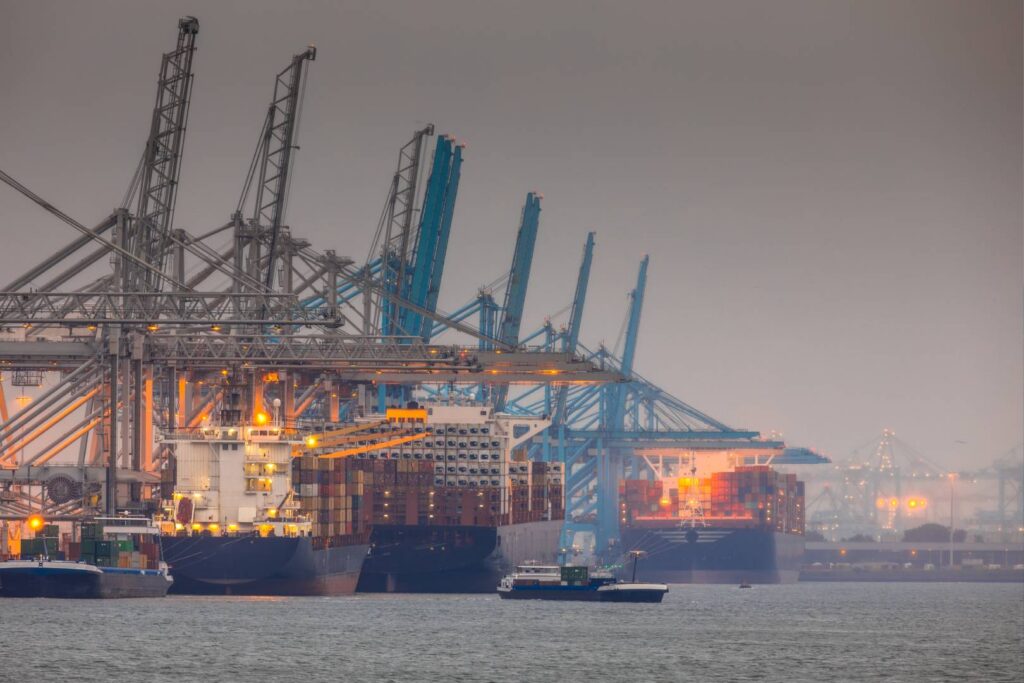
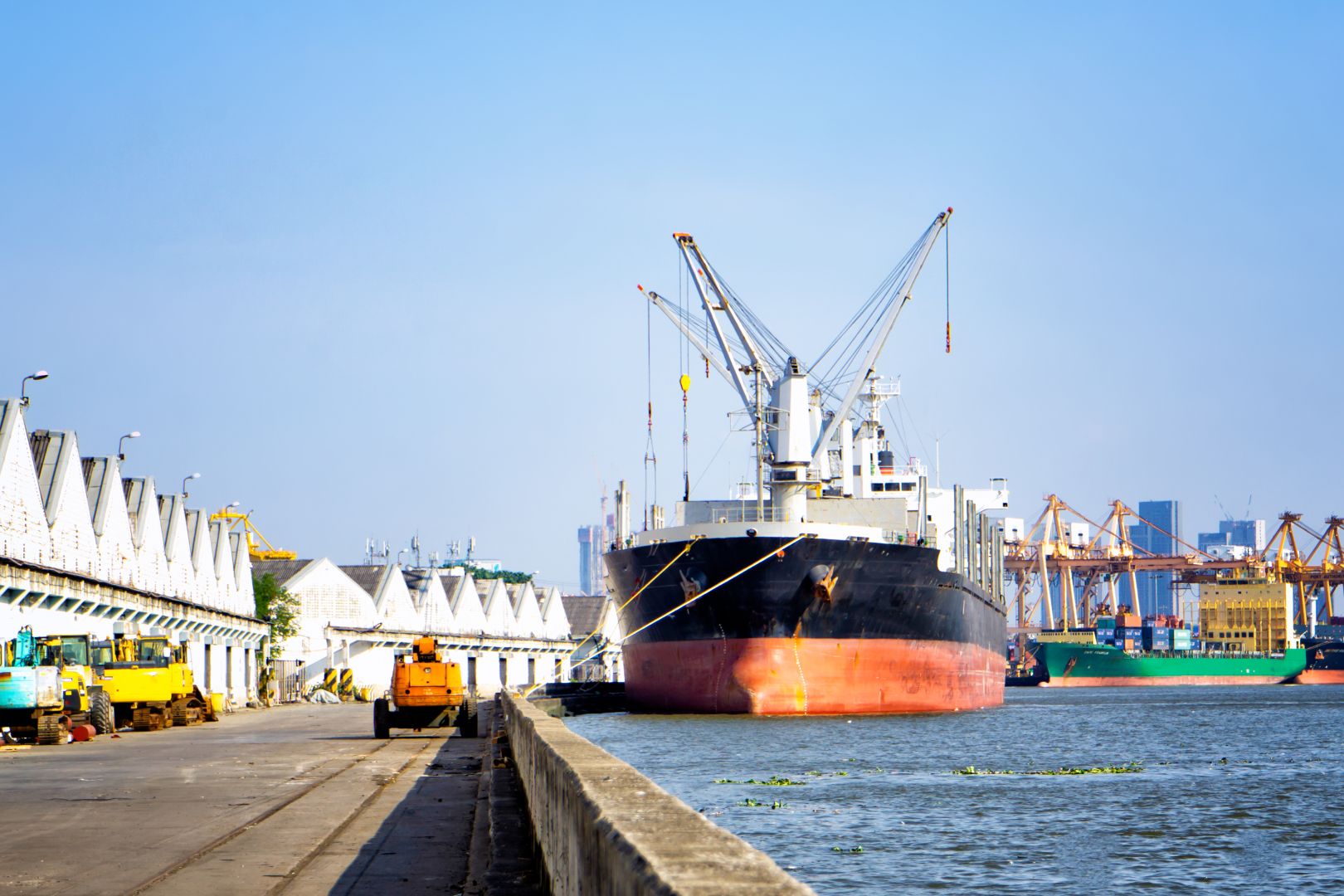
Bunker prices are elevated. The new Gulf conflict has tightened energy markets and pushed fuel costs back to levels where every nautical mile matters commercially. Geopolitical disruption is rerouting voyages, adding sea days, and compressing freight rate margins that were already under pressure from tariff volatility and demand uncertainty. This is the environment in which every carrier and cargo owner in the breakbulk sector is operating right now.
It is also, perhaps counterintuitively, the best possible environment for discussing Just-in-Time (JIT) port calls. The economics of JIT have never been more compelling. When fuel is expensive, every hour a vessel spends burning it unnecessarily at anchorage or waiting for a berth that could have been coordinated better is a quantifiable loss. And the IMO’s 50th Facilitation Committee session (FAL 50), held in London in March 2026, has just put in place the global framework to eliminate those hours at scale.
The approval of the Port Call Optimisation (PCO) Guide at FAL 50 is not a regulatory burden heading toward the breakbulk sector. It is an opportunity, one that this sector is unusually well-placed to capture, if it chooses to look at the port call through the right lens.
The Cost That Nobody Accounts For
There is a cost sitting in most breakbulk port calls that rarely appears as a line item but is paid on almost every voyage: the cost of arriving early. A vessel that steams at full speed toward port, arrives before the berth is ready, and waits at anchorage for twelve, twenty-four, or forty-eight hours has consumed fuel for a passage it did not need to make at that speed. The carrier absorbs the bunker cost. The cargo owner absorbs the schedule uncertainty. And because neither party had reliable, standardised information about when the berth would be available, no one could have planned it differently.
This is the inefficiency that JIT port call optimisation directly targets, and it is more acute in breakbulk than anywhere else in maritime trade. A heavy-lift vessel operating on a complex project cargo rotation does not have the scale advantages of a liner service to absorb anchorage waiting as background noise. Every hour at anchor is a direct cost, in fuel, in crew time, in capital tied up in a vessel that is not earning freight. For the cargo owner managing a capital project with a critical delivery window, every hour of schedule uncertainty downstream of an unpredictable berth is a contingency buffer that costs money to hold.
The PCO Guide’s mechanism for addressing this is the Requested Time of Arrival (RTA), a commitment from the port that the berth will be ready within a defined window, transmitted far enough in advance that the vessel can adjust its speed profile to arrive precisely when needed, neither early nor late. That speed adjustment, calibrated against a reliable berth commitment, is where the fuel saving lives. For a heavy-lift vessel on a long ocean passage, the difference between steaming at full speed and arriving optimally against an RTA can be measured in tonnes of bunker fuel per voyage. At current prices, that is a number worth pursuing.
What FAL 50 Actually Changed and Why It Matters Now
Port call optimisation has been discussed as a concept for years. The question has always been: optimised against what? Without a common definition of when a vessel has “arrived,” a shared understanding of the difference between a Planned Time of Arrival (PTA) and an Estimated Time of Arrival (ETA), and standardised formats for exchanging that information between ship and shore, coordination has been hopelessly fragmented. Every port has had its own conventions. Every carrier has had its own definitions. The result has been a system where everyone is technically communicating, but nobody is speaking quite the same language.
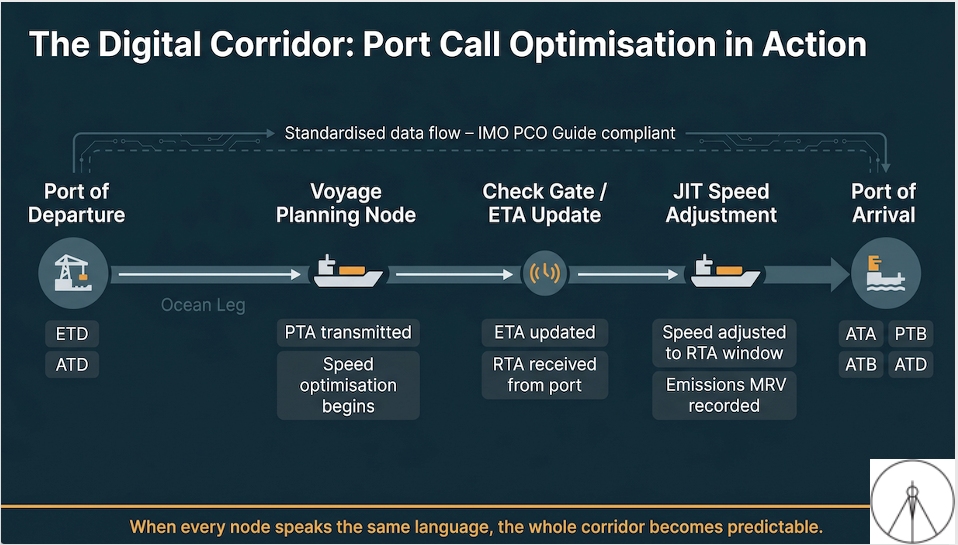
FAL 50 changed that. The PCO Guide, now formally endorsed by the IMO and anchored in the IMO Compendium on Facilitation and Electronic Business, establishes globally consistent definitions for the full suite of port call timestamps: Planned Time of Arrival at the Pilot Boarding Place (PTA PBP), Requested Time of Arrival (RTA), Actual Time of Arrival (ATA), Planned Time of Departure from Berth (PTD), and Actual Time of Departure (ATD). Each has a precise, unambiguous meaning that is now the same across the Port of Houston, the Port of Rotterdam, and the Port of Singapore.
This is the foundation the JIT argument has always needed. Not because the definitions are technically elegant, though they are, but because shared definitions create shared accountability. When a port issues a PTA and a carrier plans their voyage around it, both parties commit to the same version of reality. When performance is measured afterwards, the data is comparable. That comparability is what allows the commercial conversation about port call quality to move from anecdote to evidence.
The Digital Corridor: Seeing the Voyage Differently
The PCO Guide is built around a concept I find particularly useful for the breakbulk sector: the digital corridor. The idea is that the port call is not an isolated event at the end of a voyage. It is one node in a connected, end-to-end operating environment that begins at the port of departure and continues through to final delivery. Every data exchange along that corridor, including departure timestamps, voyage updates, arrival commitments, berth confirmations, and cargo completion estimates, feeds the next planning decision. When those data flows are standardised and reliable, the whole corridor becomes more predictable. When they are fragmented and inconsistent, uncertainty compounds at every handoff.
Project cargo operators already think in corridors. The logistics plan for a major capital project, an offshore wind installation, an LNG plant module and a mining equipment delivery to a remote port is designed end-to-end, from fabrication yard to project site. The port call sits in the middle of that plan, and its predictability or unpredictability propagates in both directions: upstream into the fabrication and load-out schedule, and downstream into the heavy transport, installation sequencing, and construction programme. Adopting the digital corridor framework for port calls is not a conceptual leap for this sector. It is simply applying the same integrated thinking to the maritime leg that already governs the rest of the logistics chain.
The PCO Guide makes that integration possible by specifying not only what data needs to be exchanged, but also in what format and via what mechanism. Timestamps in ISO 8601 format with a time zone. Berth and terminal identifiers using globally recognised GLN codes. Data exchange via API, enabling connections to Port Community Systems, Terminal Operating Systems, and Vessel Traffic Services already in place at major breakbulk ports. The technology requirement is not new infrastructure. It is the disciplined use of existing infrastructure against common standards.
The GHG Dimension: Regulation as Tailwind
The commercial case for JIT port calls stands on its own, but it is reinforced by the regulatory direction on greenhouse gas emissions. The IMO’s revised GHG strategy sets increasingly ambitious targets for reducing emissions from international shipping. At the same time, the EU’s Fit for 55 package and the Carbon Intensity Indicator (CII) regulations are already creating rating-based consequences for vessels whose operational profiles do not demonstrate year-on-year improvements in fuel efficiency.
JIT sailing is one of the most direct operational levers for improving CII ratings without capital expenditure on new propulsion technology. A vessel that consistently arrives at its berth within the planned window, having optimised its speed against a reliable RTA, demonstrably reduces its carbon intensity per voyage. This applies to breakbulk carriers managing fleets under increasing emissions scrutiny from cargo owners with their own net-zero commitments, energy majors, EPC contractors, and industrial manufacturers. Demonstrating JIT-driven emissions improvements is commercially valuable, not just for regulatory compliance.
The FAL 50 decisions regarding the PCO Guide and Maritime Autonomous Surface Ships (MASS) are interconnected. IMO is developing a unified digital infrastructure for future shipping, integrating standardized port call data, JIT operations, and autonomous vessel management into a single system. Breakbulk carriers and project cargo operators who align with the PCO Guide now are not only achieving current fuel savings but also establishing an operational framework that will benefit them over the next decade.
Where to Start: A Realistic Entry Point
The PCO Guide is structured into two compliance tiers, with the minimum tier deliberately accessible. It does not require a port to replace its systems, restructure its contracts, or implement a new technology platform. It requires the Harbour Master to act as a neutral port planner, with the authority to issue Planned Times of Arrival and Departure, publish and consistently use unique berth identifiers, and exchange timestamps digitally in a standardised format. That is the foundation. It is achievable now and serves as the entry point to being recognised as a PCO Network Port, a designation that will increasingly matter to carriers evaluating rotation options.
For carriers, the minimum entry point is equally straightforward: accept the port-issued PTA as the arrival commitment and plan the voyage speed profile accordingly, rather than defaulting to the earliest possible arrival. Apply IMO-standard definitions for ETA, ATA, and ATD. Participate in post-call reviews to drive improvement over time. None of this requires new technology. It requires operational discipline and a willingness to treat the port call as a coordinated commitment rather than an individual transaction.
The Opportunity in Front of Us
The focus session on port call optimisation is an important conversation for this sector. Port call optimisation, as the session title suggests, sounds simple. The reason it has not been simple is that the data infrastructure to support it has not existed. FAL 50 has put that infrastructure in place.
The breakbulk sector has an advantage over container trade: its port call inefficiencies have a clear, direct commercial impact, linked to specific voyages and projects. The business case for change is immediate, as savings are evident in anchorage waiting times on upcoming heavy-lift rotations.
Bunker prices are high, schedules are tight, and emissions regulations are clear. For the first time, the global maritime community has agreed on data standards, making JIT port calls manageable. This rare convergence raises a key question for the breakbulk sector: how much anchorage waiting time can you afford to pay for?
This article was originally published for The DCN, April 2026.